
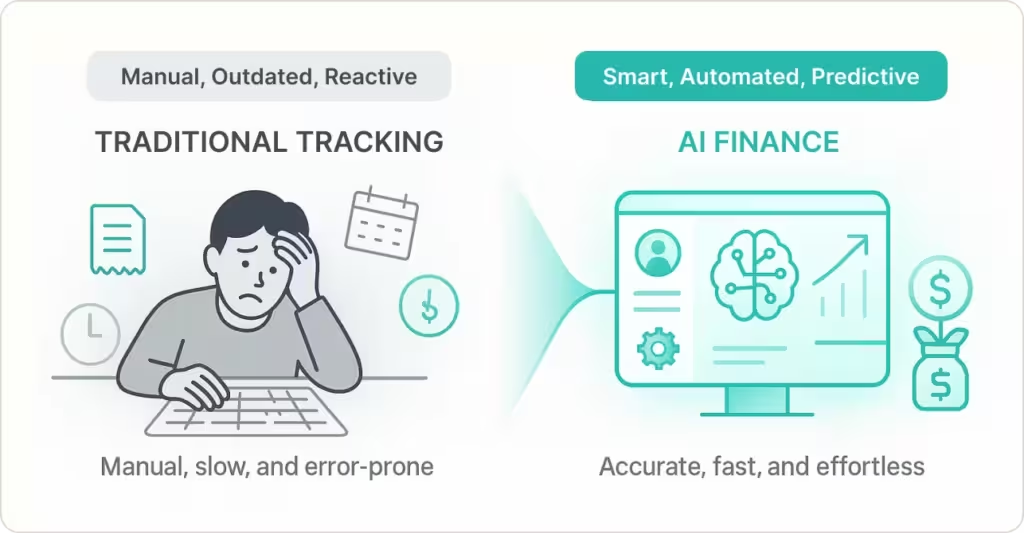
Why Your Money is Finally Smarter Than You: How AI and Data Analytics Are Revolutionizing Personal Finance
Let’s be honest: managing money is a headache. Between tracking spending, remembering bill due dates, and trying to figure out if you should invest that bonus or pay down debt, personal finance often feels like a second job.
But what if your money could manage itself?
Thanks to the rapid evolution of Artificial Intelligence (AI) and data analytics, that future is already here. We aren’t just talking about a simple budgeting app anymore. We’re talking about hyper-personalized financial assistants that predict your cash flow, optimize your savings, and even protect you from fraud before you hang up the phone.
Here is how AI and data analytics are shaping the future of personal finance, and how you can start benefiting right now.
The End of “One Size Fits All” Budgeting
Remember when “budgeting” meant stuffing cash into envelopes? Then came apps like Mint that aggregated your data into neat charts. But AI has taken this to a whole new level.
Instead of static rules (e.g., “Spend only $400 on groceries”), AI analyzes your actual behavior patterns over months. It learns that you spend more on dining out in December (holiday parties) but less in January (diet season).
The result: dynamic budgeting. Your finance app can automatically adjust your spending limits based on predicted income and seasonal trends, giving you a nudge before a “surprise” dip in your account. It knows you better than you know yourself.
How Dynamic Budgeting Works in Practice
- Adaptive categories: AI reclassifies your spending when it detects shifts, such as a new subscription or a recurring doctor visit.
- Real-time adjustments: If your income fluctuates, the app reallocates funds to essentials first, then discretionary spending.
- Behavioral nudges: You receive alerts like, “You’re 10% over your dining budget this week—consider cooking at home tonight.”
This isn’t about restriction; it’s about intelligent flexibility. The AI learns when you splurge (birthdays, vacations) and builds those moments into your plan rather than punishing you for them.
Predictive Analytics: Your Financial Crystal Ball
This is the most powerful shift. Data analytics doesn’t just tell you what you spent yesterday; it predicts what will happen tomorrow.
Cash Flow Forecasting: AI looks at your recurring income, upcoming bills, and historical spending to alert you three days before you might overdraft. It can even suggest temporarily moving money from savings to checking to avoid a fee.
Investment Insights: Robo-advisors like Betterment and Wealthfront use algorithms to balance your portfolio in real-time based on market data and your risk tolerance. But newer AI tools can now analyze global economic news to predict market shifts, not just react to them.
Goal Achievement: Want to buy a house in 5 years? AI can run millions of simulations based on your savings rate, variable interest rates, and potential raises to tell you exactly how much you need to save each month to hit that target.
The Predictive Edge for Everyday Decisions
Consider this scenario: Your AI assistant notices your car insurance renewal is due next month—historically a $1,200 expense. It immediately:
- Searches for competing quotes from other insurers.
- Calculates whether switching saves more than the loyalty discount.
- Recommends moving $100 per week from your “fun money” category to cover the difference.
This isn’t science fiction. Banks like Capital One and JPMorgan Chase already deploy similar analytics in their mobile apps, giving users a level of foresight that was once reserved for wealth managers charging $300 per hour.
The Rise of the “Invisible” Bank
The ultimate goal of AI in finance is for the tool to work so you don’t have to.
The original article highlights a shift toward “invisible banking”—where the technology integrates into your life rather than you logging into a dashboard. Imagine this:
- Instant rewards: You stop buying coffee at the local shop because the AI detected your savings account is low? The bank lowers your credit card interest rate for that month as a reward for good behavior.
- Automatic debt payoff: Your app spots a surplus in your checking account and automatically sweeps it toward your highest-interest credit card debt.
- Context-aware alerts: Instead of a generic “Low balance” notification, you get: “Your electric bill is due in 3 days. Would you like to delay your streaming subscription payment by 5 days to avoid an overdraft fee?”
This frictionless experience relies entirely on real-time data analytics. The AI operates in the background, processing thousands of data points per second, and only surfaces when action is needed.
Why This Matters for Your Wallet
The average American loses $300 per year in overdraft fees, late payments, and missed savings opportunities. Invisible banking eliminates these by automating decisions that humans routinely forget or avoid.
Fraud Detection That Happens in a Millisecond
We’ve all gotten that annoying “Did you make this purchase?” text. But by the time you see it, the crook has already tried to drain your account.
Modern AI fraud detection is different. It uses behavioral biometrics—analyzing how fast you type, the pressure of your touch, or your phone’s GPS location—to verify your identity. If a transaction deviates from your “digital fingerprint,” the AI can freeze the transfer before it completes, saving you the headache of a chargeback dispute.
How Next-Gen Fraud Protection Works
- Location analysis: The system cross-references your card’s use with your phone’s GPS. If your card is swiped in Chicago while your phone is in New York, the transaction is blocked.
- Purchase pattern deviation: You always buy gas at $40. A $200 gas purchase triggers an immediate alert, not after the fact.
- Time-of-day learning: If you never shop at 3 AM, the AI flags any midnight transactions as suspicious.
Data from the Federal Trade Commission shows that consumers lost over $10 billion to fraud in 2023. AI-driven detection is cutting those losses by an estimated 40% for financial institutions that deploy it aggressively.
The Bottom Line (In Your Bottom Line)
The era of confusing spreadsheets and generic financial advice is ending. AI and data analytics are democratizing financial expertise—giving the average person the tools that used to be reserved for Wall Street millionaires.
How to start today:
- Update your app: Check your banking app for “Insights” or “Analytics” tabs. Most major banks now include them in settings.
- Try a smart savings tool: Apps like YNAB (You Need A Budget) or Copilot are leading the charge in AI integration, offering features like automated categorization and predictive cash flow.
- Enable push notifications: Turn on personalized alerts for your bank. These are often powered by AI that learns your habits and warns you about unusual activity.
- Talk to your bank: Ask if they offer an AI-powered financial assistant. Some, like Erica from Bank of America or Eno from Capital One, are already available and free to use.