Debt Snowball vs. Debt Avalanche: Which Strategy Actually Gets You Out of Debt?
If you’ve ever stared at a list of debts wondering where to even begin, you’re not alone. Between credit cards, personal loans, and car payments, it can feel like every peso you earn is already spoken for before you even get it. The good news is there are two proven strategies that have helped millions of people work their way out of debt — the debt snowball and the debt avalanche — and understanding the difference between them could change how quickly you reach financial freedom.
What the Debt Snowball Method Actually Means
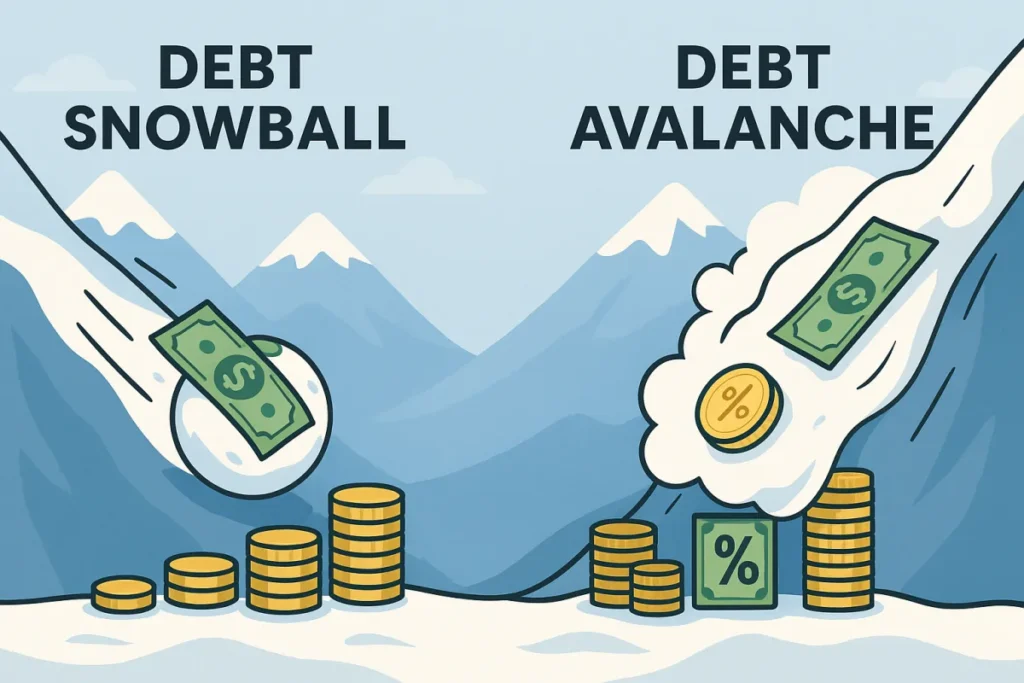
The debt snowball method was popularized by personal finance author Dave Ramsey, and its core principle is straightforward: pay off your smallest debt first, regardless of interest rate, while making minimum payments on everything else. Once that smallest balance is cleared, you roll that freed-up payment into the next smallest debt — and so on, building momentum as you go.
To illustrate, suppose you owe ₱15,000 on a credit card, ₱100,000 on a personal loan, and ₱500,000 on a car loan. Under the snowball method, you’d attack that ₱15,000 balance first. Once it’s gone, you redirect that monthly payment toward the personal loan. The idea is that each paid-off account gives you a psychological boost — a real, tangible win — that keeps you motivated for the longer road ahead.
The downside worth knowing: because interest rates don’t factor into the order, you may end up paying more overall compared to other strategies. A ₱15,000 balance at 5% interest costs far less to carry than a ₱100,000 balance at 24% — but the snowball method has you ignoring that math in favor of momentum.
What the Debt Avalanche Method Actually Means
The debt avalanche takes the opposite approach. Instead of targeting the smallest balance, you go after the debt carrying the highest interest rate first — again, while making minimum payments on everything else. It’s a strategy rooted in math rather than motivation.
Using the same example, if your car loan carries a 30% annual interest rate versus your credit card’s 18%, you’d prioritize the car loan under the avalanche method — even though the balance is significantly larger. Over time, eliminating high-interest debt first reduces how much you pay in total, and technically shortens the overall repayment timeline.
The trade-off is patience. When your highest-interest debt also happens to be your largest, it could take months or even years before you see your first account fully paid off. For some people, that’s manageable. For others, the lack of early wins makes it hard to stay consistent.
How the Two Methods Compare Side by Side
Both strategies require the same foundational commitment: stop adding new debt, make payments consistently, and put whatever extra money you can toward the priority account each month. Neither works without that discipline in place.
Where they diverge is in what they optimize for. The snowball optimizes for motivation and behavioral momentum — it’s designed for people who know from experience that they need early wins to stay on track. The avalanche optimizes for total cost — it’s better suited for people who are financially disciplined and can stay focused on a long-term goal without needing frequent reinforcement along the way.
Research from the Harvard Business Review has actually supported the snowball approach for many borrowers, finding that the sense of progress from eliminating individual accounts keeps people engaged longer. Meanwhile, a straightforward interest rate calculation will almost always favor the avalanche — assuming you stick with it.
Which One Makes More Sense for You
Choosing between the two comes down to knowing yourself honestly. If you’ve tried to pay off debt before and lost steam, or if you’re juggling five or six accounts and feel paralyzed by the sheer number of them, the snowball method gives you a clear, achievable first target. Getting that first balance to zero is a real milestone worth something.
On the other hand, if you’re carrying one or two large debts with steep interest rates and you have the discipline to stay focused without needing early wins, the avalanche will save you money — sometimes a significant amount over a multi-year repayment period.
Some people also use a hybrid approach: start with the snowball to build confidence and eliminate a couple of smaller accounts, then switch to the avalanche once the debt list feels more manageable. There’s nothing wrong with that. The goal is to finish debt-free, not to follow a textbook perfectly.
Practical Steps Regardless of Which Method You Choose
Before committing to either strategy, it helps to get everything down on paper. List every debt you carry — the outstanding balance, the interest rate, and the minimum monthly payment. Seeing the full picture in one place makes it easier to prioritize and harder to ignore.
From there, set a realistic monthly amount you can put toward debt beyond the minimums. Even a modest extra payment, applied consistently month after month, makes a measurable difference over time. Automating your payments removes one more decision from your plate and prevents missed due dates from derailing your progress.
Finally, track your balances regularly — monthly tends to work well for most people. Watching the numbers shrink, even slowly, reinforces that the effort is working.
When to Consider Debt Consolidation Instead
If you’re managing several high-interest debts simultaneously and the juggling act itself is the problem, consolidation is worth exploring. Rolling multiple balances into a single loan at a lower interest rate simplifies your monthly obligations and can reduce what you’re paying in interest overall. It’s not a substitute for a repayment strategy, but it can make either the snowball or avalanche significantly easier to execute.
The Bottom Line
Neither the debt snowball nor the debt avalanche is universally superior. Both have worked for real people carrying real debt, and both will work for you — provided you choose one and follow through. The worst outcome isn’t picking the “wrong” strategy. It’s spending so long deciding that you delay starting altogether.
Pick the method that fits how you’re wired, build the habits that support it, and give it time. Debt that took years to accumulate won’t disappear in a month, but with a consistent approach, it will disappear.